• UGM
  • IT Center
  • Library
  • Journal of Psychology
  • LPPM UGM
  • UGM Mail
  • Bahasa Indonesia
    • Bahasa Indonesia
    • English
Universitas Gadjah Mada Center for Indigenous and Cultural Psychology
Fakultas Psikologi, Universitas Gadjah Mada
  • Home
  • Tentang CICP
    • Selayang Pandang Indigenous Psychology
    • Sambutan Direktur
    • Sejarah CICP
    • Visi dan Misi
    • Staff
    • Anggota
  • Kegiatan
    • Konferensi
    • Konsentrasi Penelitian
      • Konsentrasi Penelitian 2021
      • Konsentrasi Penelitian 2020
      • Konsentrasi Penelitian 2019
    • Kegiatan Terlaksana
    • Kegiatan Rutin
      • CICP Publication Workshop
      • School of Researcher
      • THEORY BUILDING TRAINING
    • Kegiatan Mendatang
    • Magang Internal
      • Prosedur Magang Internal (UGM)
      • Rekap Magang Internal 2018
      • Rekap Magang Internal 2019
    • Magang External
      • Prosedur Magang Eksternal (Asing dan Non-UGM)
      • Alumni Magang Eksternal
  • Publikasi
    • Jurnal
    • Working Paper Series
    • Buku
    • Policy Brief CICP
    • Artikel Lain
  • Home
  • Journal Articles

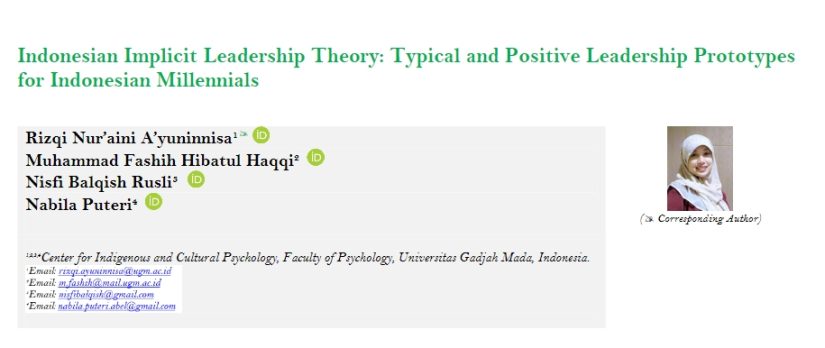
Indonesian Implicit Leadership Theory: Typical and Positive Leadership Prototypes for Indonesian Millennials

  • Journal Articles
  • 4 Februari 2022, 13.05
  • Oleh : admin

ABSTRACT. Leadership studies in Indonesia tend to discuss the way leadership affects individual attitudes and behavior as well as team effectiveness. However, a more contextual and recent approach study in understanding leadership remains underdeveloped. As a preliminary, this study aims to explore the concept of Indonesia’s leadership based on local perspectives by taking into account Implicit Leadership Theory. Data were gathered by involving 404 millennials (63,6% female, 36,4% male) using an open-ended question namely “Describe three characteristics of a leader” and two scales asking participants’ perception about how typical and effective each leaders’ characteristic count for leadership. A total of 1159 responses were analyzed using thematic analysis and demonstrated four characteristics depicting prototypes of leaders namely moral (41,07%), generally-competent (29,42%), charismatic (20,79%), conscientious (8,71%). A one-way ANOVA was also conducted to compare the effect of leader’s prototypes on perception of typicality and effectiveness of leadership. There was a significant effect of leadership prototypes on perception of typical leadership at the p<.05 level for the three conditions for each of perception about how typical and effective the prototypes reflect leadership. However, at the level of prototypes, no differences were found in perceiving which prototypes were considered as more typical and effective. The descriptive scores of each prototype indicates all of the prototypes were perceived as high in reflecting typicality and effectiveness in leadership. In conclusion, all leadership prototypes emerged from the responses were perceived as both typical and effective by the participants.


Tinggalkan Komentar

Alamat email Anda tidak akan dipublikasikan. Ruas yang wajib ditandai *

Related Posts

Lebih dari Sekedar Pencari Nafkah: Bagaimana Para Ayah Pekerja Belajar Hadir untuk Anak

Public Release Sabtu, 10 Oktober 2026

   Catatan. Diambil dari To Dad, With Love: A Daughter’s Account Of Growing Up With A Loving  Father, oleh Youth Ki Awaaz, 2013 (youthkiawaaz.com).  Hak Cipta 2019 oleh Getty Images/Comstcok Empat orang ayah bercerita mengenai […].

Melihat Eksistensi Selasar Psikologi dan Fungsinya yang Tak Terbatas

Public Release Sabtu, 10 Oktober 2026

Kampus merupakan panggung utama interaksi antara dosen dan mahasiswa untuk bertukar pikiran. Kampus tidak terbatas pada sekat maupun dinding bangunan fisik yang menaungi kepala kita untuk belajar.

Salahkah Kita Meninggalkan Relasi Pertemanan?

Public Release Sabtu, 10 Oktober 2026

Berteman dipandang sebagai suatu kebutuhan. Manusia seringkali membutuhkan relasi pertemanan dalam menunjang kehidupannya, terutama dalam menghadapi tantangan hidup. Unsur-unsur seperti dukungan, afeksi, dan berbagi merupakan hal yang didapatkan dari pertemanan.
Gambar 1. Masyarakat di desa adat. (Sumber: https://www.pexels.com/photo/traditional-indigenous-village-scene-with-tribal-people-32696007/)

Fortress Conservation: Driving Out Protectors in the Name of Protection

Public Release Rabu, 23 September 2026

Image 1. People in a traditional village. (Source: https://www.pexels.com/photo/traditional-indigenous-village-scene-with-tribal-people-32696007/) Humans are born of nature and live according to the laws of nature.
Universitas Gadjah Mada

Alamat: Ruang D604 Gedung D lt. 6, Fakultas Psikologi Universitas Gadjah Mada,
Jalan Humaniora Bulaksumur, Sleman, Yogyakarta 55281 INDONESIA

Jam Kerja: 08.00 – 16.00
Telepon: (+62)274-550435 ext. 604
Humas CICP: (+62)857-2868-1391
Fax: (+62)274-550436

Email: cicp@ugm.ac.id

Instagram: @cicp.ugm

© Universitas Gadjah Mada