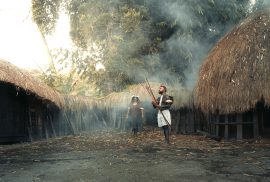
Image 1. People in a traditional village.
(Source: https://www.pexels.com/photo/traditional-indigenous-village-scene-with-tribal-people-32696007/)
Humans are born of nature and live according to the laws of nature. Our life and survival depend on resources from the surrounding environment and ecological balance with nature, because humans are part of nature itself (Schultz, 2002). In Indonesia, the relationship between humans and nature is particularly strong, given the country’s abundance of natural resources, diverse local cultures, and the presence of indigenous communities that maintain reciprocal relationships with the land, sea, forests, and wildlife around them (Riyanto, 2015).
. . .
Humans depend on nature for their survival and play a role in managing existing ecosystems. Before they gradually gave way to rows of towering buildings and vast stretches of asphalt, various types of landscapes served as homes where people returned and settled. Amid the surge of modernization and technological advancement, indigenous communities in various regions today still maintain the way of life they’ve built on the land of their ancestral homelands—which they care for and respect—and rely on a natural environment untouched by the steel of construction. However, as more and more natural landscapes are leveled and repurposed for industrial use, areas with natural ecosystems still untouched by modernization are becoming increasingly rare. Unfortunately, people who are accustomed to living surrounded by technology created by their fellow humans feel that such environments need to be protected from the selfish interference of humanity.
Indigenous communities still maintain strong ties with their natural environment. On the other hand, modern society views the separation of humans from a conservation area as the right step, so that nature remains free from creatures capable of exploiting it. However, is separating communities that have long been part of that ecosystem the right way to “protect” nature? Given that humans are a component of nature itself, is removing local residents from that natural environment a wise move for preserving an ecosystem that has long coexisted with them? The separation of protected areas from the very people who have safeguarded them—in the name of “conservation”—has become a manifestation of the strained relationship between humans and nature.
. . .
Fortress Conservation: Conservation Without Humans
Conservation refers to the regular maintenance and protection of something to prevent damage and destruction through preservation, conservation, or safeguarding (Kamus Besar Bahasa Indonesia (KBBI), n.d.). Environmental conservation is an effort to protect, care for, and manage ecosystems so that they remain sustainable and can be enjoyed by both current and future generations (Hadinoto et al., 2025). It can be understood that environmental conservation is a systematic effort to maintain, protect, and preserve ecosystems to prevent further damage so that nature can continue to be enjoyed by future generations.
Conservation strategies are divided into two categories: in situ and ex situ conservation. Ex situ conservation involves preserving species outside their natural habitats, usually because those habitats are already threatened. In situ conservation preserves species directly within their natural habitats, allowing organisms to reproduce and interact with their environment naturally. Typically, in situ conservation takes the form of national parks used for research, education, and tourism, as well as strictly protected nature reserves free from human intervention to safeguard a unique ecosystem (Agustina et al., 2025).
In Indonesia, National Law No. 32 of 2024—an update to National Law No. 5 of 1990 on the Conservation of Biological Resources and Their Ecosystems—approaches conservation through three pillars: utilization, preservation, and protection. However, this regulation has proven to be prone to triggering land conflicts and has the potential to harm indigenous communities that have long lived in harmony with the local environment (Zainuddin, 2025).
The “fortress conservation” approach is based on the idea that indigenous communities’ use of forests can threaten biodiversity, and therefore their habitats must be protected by force whenever possible (Rai et al., 2021). A defining characteristic of fortress conservation is the establishment of protected areas that exclude indigenous communities whose livelihoods depend on the resources within those ecosystems. This approach is also often linked to the notion that the only acceptable uses of protected areas are for tourism, safari hunting, and scientific research (Robbins et al., 2012).
. . .
Separated from Komodo: Ata Modo and the Impact of Fortress Conservation

(Source: https://jernih.co/potpourri/mengenal-ata-modo-saudara-kandung-komodo/)
The indigenous people of Komodo Island, known as the Ata Modo, are one example of a community affected by the “fortress conservation” system in Indonesia. The Ata Modo have long lived alongside Komodo dragons as part of their natural environment. Although interactions between the Ata Modo and Komodo dragons do not always go smoothly, they rarely retaliate against Komodo dragons that attack humans or livestock. They hold a deeply ingrained belief that Komodo dragons are their own siblings, born of the same mother. This belief, combined with local culture, allows the Ata Modo to maintain a harmonious relationship with the natural environment in which they live (Panggur et al., 2023).
In the 1970s, the Ata Modo were forced to relocate from Loh Kiang to Komodo Village as part of conservation efforts in their homeland, which is now Komodo National Park. The residents faced intimidation and threats during the process, one of which was the mass killing of their pet dogs. The Ata Modo’s lives changed drastically, becoming one of severe restrictions on their own land following the eviction carried out in the name of conservation. They were prohibited from fishing and had to abandon their traditions of hunting and gathering. The Ata Modo’s livelihoods, which were originally dominated by fishing, have also shifted to working as tour guides and souvenir vendors due to the transformation of their residential area into a tourist destination. The Ata Modo have lived on Komodo Island since before the nation was founded, yet they are now labeled as illegal residents and evicted simply because they lack official land certificates (Nababan, 2024).
The government and private conservation organizations believe that nature conservation can only be achieved through natural national parks free from human involvement. Authorities forcibly evict local indigenous communities, even though they are the ones who have lived in and cared for these areas for centuries (Knox, 2024). According to the Working Group on ICCAs Indonesia (WGII) website (n.d.), many conservation policies in Indonesia still rely on the “fortress conservation” paradigm. The state maintains full control over conservation areas and acts repressively toward indigenous communities, whom it views as a threat to nature’s sustainability. Yet, every decision regarding protected areas and conservation laws directly impacts the human rights of indigenous communities who have occupied that land for generations. The key rights at stake include the right to land ownership, culture, livelihoods, food, a decent standard of living, equality, participation in decisions regarding one’s land and resources, as well as the right to legal remedies and compensation for violations (Kasimbazi et al., 2026).
Areas with high biodiversity have been able to form and persist thanks to management by local indigenous communities since ancient times (Willis et al., 2024; Clement et al., 2015; Thekaekara et al., 2017). Indigenous peoples’ deep and holistic understanding of the ecosystems in which they live is rooted in a respect for the relationship between humans and nature, continuous observation, and spiritual protection of their land. They treat their ancestral lands as living beings—sources of identity, spirituality, and well-being—rather than as resources to be exploited (Mendúa, 2025). Research by Schuster et al. (2019) compared biodiversity between areas managed by indigenous communities and protected areas in Australia, Brazil, and Canada. The findings revealed that areas managed by indigenous communities possess greater biodiversity than protected areas. A study by Sheil et al. (2015) in Papua also found that natural resource management by indigenous communities is more effective and cost-efficient than government-managed protected areas. In fact, conservation areas can be harmed if indigenous communities are removed from their environments—even after they have provided good stewardship—and replaced with government-managed protected areas, given the limitations of the government’s capabilities.
. . .
Reflection: Conservation That Excludes or Conservation That Protects?
Given the challenges of forced eviction faced by the Ata Modo community, as well as a comparison of biodiversity in areas managed by indigenous communities versus those managed by the government, the strained relationship between humans and nature is cause for reflection. The motivation behind conservation efforts is worth questioning, since indigenous communities, conservation organizations, and the government all share the goal of preserving nature that remains untouched by modernization.
Can indigenous communities in an area with unique biodiversity be considered “not part of the existing ecosystem”? Given the history of indigenous communities’ involvement in maintaining the balance of the ecosystems where they live, it seems inappropriate to view their presence as a “disruption” to environmental conservation efforts. Just because our relationship—as modern society—with nature has long since weakened does not mean we have the right to assume that every human being, especially indigenous peoples, is a party that will always harm the well-being of nature itself. Given the evidence that areas managed by indigenous communities are actually more sustainable than those resulting from “fortress conservation,” isn’t it “artificial conservation” that has the potential to disrupt an ecosystem’s balance by excluding indigenous communities as an integral part of nature?
If conservation is carried out in the name of protecting nature, why do we feel the need to separate indigenous communities that have long cared for their own homelands?
It is time for us to realize that humans—whether modern societies or indigenous communities—are part of nature itself and partners in the effort to protect the environment in which we live. Amid the tide of modernization and industrialization that pursues maximum profit for human greed, we must remember that sacrificing the very life of nature as our home, is not a wise move. This is especially true when it comes to displacing indigenous communities as the true stewards of conservation from their homelands, which remain intact thanks to their own contributions. All of us, humans, animals, plants, water, soil, the sky, and the earth, form a single, unified whole within the universe.
REFERENCES
Agustina, R., Aditiameri, Ahmad, A., Tebai, N., Fidhatami, I. I., La Habi, M., Kartini, N. L., Irawati, Rifandi, R. A., & Azizah, A. (2025). Konservasi Sumber Daya Alam dan Lingkungan. Azzia Karya Bersama.
Anggraini, F., & Sjah, T. (2024). Antropologi lingkungan: Meninjau kembali hubungan manusia dengan alam dari sudut pandang filosofis. Jurnal Ilmiah Sains dan Teknologi, 3(2), 642-648.
Bulumanu, E., & Riyanto, A. (2024). Relasionalitas hubungan manusia dan alam semesta dalam fenomena anomali iklim di Indonesia. Journal Scientific of Mandalika (JSM), 5(6), 265-274. https://doi.org/10.36312/jomla.v5i6.2421
Clement, C. R., Denevan, W. M., Heckenberger, M. J., Junqueira, A. B., Neves, E. G., Teixeira, W. G., & Woods, W. I. (2015). The domestication of Amazonia before European conquest. Proceedings. Biological sciences, 282(1812), 20150813. https://doi.org/10.1098/rspb.2015.0813.
Hadinoto, H., Suhesti, E., RA, D. S., & Akbar, M. A. (2025). Konservasi Lingkungan bagi Siswa Madrasah Tsanawiyah di Kota Pekanbaru. Jurnal Pengabdian Masyarakat Bangsa, 3(5), 2117-2129.https://doi.org/10.59837/jpmba.v3i5.2666
Kasimbazi, E., & Kezaabu, A. (2026). Fortress conservation and human rights violations against marginalized communities in Uganda. Journal of Law, Policy and Globalization, 151, 1–12. https://doi.org/10.7176/JLPG/151-01
Badan Pengembangan dan Pembinaan Bahasa. (n.d.). Konservasi. Kamus Besar Bahasa Indonesia Daring. Kementerian Pendidikan, Kebudayaan, Riset, dan Teknologi. https://kbbi.web.id/konservasi
Knox, J. H. (2024, December 10). New set of human rights principles aims to end displacement and abuse of Indigenous people through ‘fortress conservation’. The Conversation. https://theconversation.com/new-set-of-human-rights-principles-aims-to-end-displacement-and-abuse-of-indigenous-people-through-fortress-conservation-242891
Mendúa, J. I. (2025, April 29). Guardians of the Earth: The essential role of Indigenous Peoples in the protection of natural resources. The Global Goals. https://globalgoals.org/news/guardians-of-the-earth-the-essential-role-of-indigenous-peoples-in-the-protection-of-natural-resources/
Nababan, W. M. C. (2024, January 26). Warga Pulau Komodo Hidup dalam Bayang-bayang Pengusiran. Konsorsium Pembaruan Agraria. https://www.kpa.or.id/2024/01/warga-pulau-komodo-hidup-dalam-bayang-bayang-pengusiran/
Panggur, M. R., Wijayanti, A., Ardiantiono, Roy, L. (2023, December 24). Hidup Harmonis dengan Komodo. Current Conservation. https://www.currentconservation.org/hidup-harmonis-dengan-komodo/
Rai, N. D., Devy, M. S., Ganesh, T., Ganesan, R., Setty, S. R., Hiremath, A. J., … & Rajan, P. D. (2021). Beyond fortress conservation: the long-term integration of natural and social science research for an inclusive conservation practice in India. Biological Conservation, 254, 108888. https://doi.org/10.1016/j.biocon.2020.108888
Riyanto, A. (2015). Kearifan lokal-Pancasila: Butir-butir filsafat keindonesiaan. PT Kanisius.
Robbins, P., Doolittle, A. A. (2007). Fortress conservation. Encyclopedia of environment and society (Vol. 5, pp. 705-705). SAGE Publications, Inc. https://doi.org/10.4135/9781412953924.n432
Schultz, P. W. (2002). Inclusion with nature: The psychology of human-nature relations. In Psychology of sustainable development (pp. 61-78). Boston, MA: Springer US.
Schuster, R., Germain, R. R., Bennett, J. R., Reo, N. J., & Arcese, P. (2019). Vertebrate biodiversity on indigenous-managed lands in Australia, Brazil, and Canada equals that in protected areas. Environmental Science & Policy, 101, 1-6. https://doi.org/10.1016/j.envsci.2019.07.002.
Sheil, D., Boissière, M., & Beaudoin, G. (2015). Unseen sentinels: local monitoring and control in conservation’s blind spots. Ecology and Society, 20(2). http://dx.doi.org/10.5751/ES-07625-200239.
Thekaekara, T., Vanak, A. T., Ankila Hiremath, J., Rai, N. D., Ratnam, J., & Raman, S. (2017). Notes from the other side of a forest fire. Economic & Political Weekly, 52(25-26), 22-25.
Willis, K. J., Gillson, L., & Brncic, T. M. (2004). How” virgin” is virgin rainforest?. Science, 304(5669), 402-403. https://doi.org/10.1126/science.1093991.
Republik Indonesia. (2024). Undang-Undang Nomor 32 Tahun 2024 tentang Perubahan atas Undang-Undang Nomor 5 Tahun 1990 tentang Konservasi Sumber Daya Alam Hayati dan Ekosistemnya. Lembaran Negara Republik Indonesia Tahun 2024 Nomor 138. Database Peraturan BPK. https://peraturan.bpk.go.id/Details/295135/uu-no-32-tahun-2024.
Zainuddin, A. (2025, September 1). Konservasi yang Tak Manusiawi. Balairung Press. https://balairungpress.com/2025/09/konservasi-yang-tak-manusiawi/