• UGM
  • IT Center
  • Library
  • Journal of Psychology
  • LPPM UGM
  • UGM Mail
  • English
    • Bahasa Indonesia
    • English
Universitas Gadjah Mada Center for Indigenous and Cultural Psychology
Fakultas Psikologi, Universitas Gadjah Mada
  • Home
  • Tentang CICP
    • Selayang Pandang Indigenous Psychology
    • Sambutan Direktur
    • Sejarah CICP
    • Visi dan Misi
    • Staff
    • Anggota
  • Kegiatan
    • Konferensi
    • Konsentrasi Penelitian
      • Konsentrasi Penelitian 2021
      • Konsentrasi Penelitian 2020
      • Konsentrasi Penelitian 2019
    • Kegiatan Terlaksana
    • Kegiatan Rutin
      • CICP Publication Workshop
      • School of Researcher
      • THEORY BUILDING TRAINING
    • Kegiatan Mendatang
    • Magang Internal
      • Prosedur Magang Internal (UGM)
      • Rekap Magang Internal 2018
      • Rekap Magang Internal 2019
    • Magang External
      • Prosedur Magang Eksternal (Asing dan Non-UGM)
      • Alumni Magang Eksternal
  • Publikasi
    • Jurnal
    • Working Paper Series
    • Buku
    • Policy Brief CICP
    • Artikel Lain
  • Home
  • Public Release

A Session with Prof. Jaan Valsiner and Assoc. Prof. Giuseppina Marsico: CICP’s Summer Course Explores the Meaning of Human Experience in Psychology and Culture

  • Public Release
  • 25 July 2025, 15.28
  • By : admin

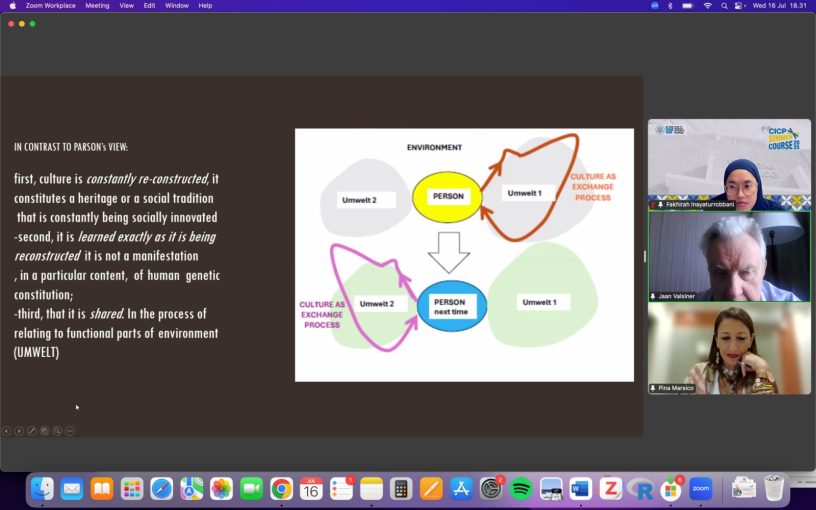
Wednesday (16/07), has been presented the first lecturer session in International Summer Course CICP 2025. This session titled “The Dynamic Nature of Psychological Phenomena: Where Cultural Psychology Solves the Main Problem of General Psychology” by Prof. Jaan Valsiner (Aalborg University) and Assoc. Prof. Giuseppina Marsico (the University of Salerno). Valsiner and Marsico addressed a fundamental shortcoming in mainstream psychology—its neglect of semiosis, the process through which meaning is created and understood in human experience. Marsico delivered a sharp critique of the historical trajectory of psychology, arguing that throughout the 20th century, the discipline failed to recognize meaning-making as a central psychological process, thereby sidelining a crucial dimension of the human mind.

According to Marsico, mainstream psychology largely abandoned its responsibility to explore how individuals make sense of their lives and surroundings. Cultural psychology, on the other hand, offers a more relevant and nuanced theoretical framework to understand this core aspect of human existence. From this perspective, culture is not a fixed entity passed across generations, but a dynamic, ongoing process reconstructed through the continuous interaction between individuals and their social environments.

Jaan Valsiner further elaborated on this framework by emphasizing the importance of understanding the dual temporal and experiential dimensions that shape our lives—the past and the future, the inner and the outer worlds. Drawing on William Stern’s concept of “infinity” in psychology, Valsiner stressed the idea that human life is always situated within a flow of time and meaning. Cultural psychology, he argued, seeks to coordinate our internal self-reflections with our evolving relationship to time and context.

Valsiner introduced his concept of semiotic dynamics—the idea that our lives are governed by signs that we actively create to interpret and navigate experience. These signs regulate not only our present emotions but also shape our future orientation and development. Culture is thus co-constructed through internalization and externalization of meaning, and through the coordination among social agents. Situated between the internal dimensions of the self (I and ME) and the external world (ME and YOU), culture becomes a site of dynamic mediation. Rather than drawing a strict line between the individual and society, cultural psychology sees their relationship as dialogical and ever-evolving. The lecture concluded with the affirmation that culture cannot exist without its creators. Cultural psychology, therefore, centers on the human being as an active, reflective, and meaning-making agent—offering an essential corrective to traditional psychology’s overly mechanistic view of the mind.
Tags: SDG 10: Reduced Inequalities SDG 4: Quality Education

Leave A Comment

Your email address will not be published. Required fields are marked *

Related Posts

Extended Registration for International Summer Course 2026

Public Release Monday, 27 July 2026

📢 Great news! We’ve extended the registration deadline! Missed the previous deadline? Here’s another opportunity to join our International Summer Course 2026: Understanding Solidarity in the Global South: Cultural and Social Psychological Perspectives.

INTERNATIONAL SUMMER COURSE 2026

Upcoming Activity Tuesday, 21 July 2026

🌏 INTERNATIONAL SUMMER COURSE 2026 Understanding Solidarity in the Global South: Cultural and Social Psychological Perspectives Join participants from around the world in this fully online summer course hosted by the Center for Indigenous and […].

Angkringan #29 titled “What Matters is Horeg: A View from the Margins”

Public Release Thursday, 30 April 2026

In the 29th edition of Angkringan, CICP UGM invited Ahmad Yusrifan (Mas Yus) to share his experience researching the phenomenon of sound horeg, which has become a distinctive form of entertainment in village carnivals in East Java and several other regions in Java. Sound horeg refers to a collection of large-scale sound systems with powerful bass whose vibrations can be felt physically by the body and the surrounding environment.

Interfacing Culture: Multisensory Ethnography in the Digital Era

Public Release Saturday, 26 July 2025

Monday (21/07) — In a thought-provoking session of the 2025 Summer Course “Beyond Boundaries” hosted by CICP, psychology and culture came under fresh light with a lecture by renowned scholar Dr. Muhammad Zamzam Fauzanafi, M.A, […].
Universitas Gadjah Mada

Alamat: Ruang D604 Gedung D lt. 6, Fakultas Psikologi Universitas Gadjah Mada,
Jalan Humaniora Bulaksumur, Sleman, Yogyakarta 55281 INDONESIA

Jam Kerja: 08.00 – 16.00
Telepon: (+62)274-550435 ext. 604
Humas CICP: (+62)857-2868-1391
Fax: (+62)274-550436

Email: cicp@ugm.ac.id

Instagram: @cicp.ugm

© Universitas Gadjah Mada