
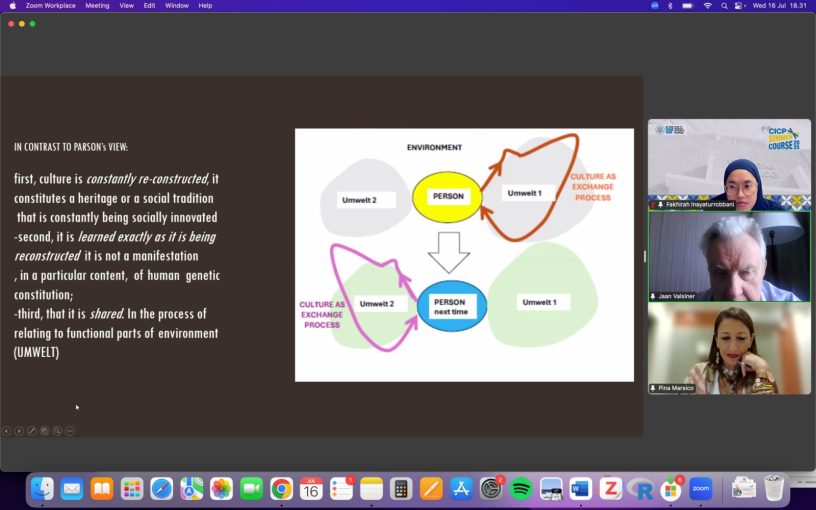
Wednesday (16/07), has been presented the first lecturer session in International Summer Course CICP 2025. This session titled “The Dynamic Nature of Psychological Phenomena: Where Cultural Psychology Solves the Main Problem of General Psychology” by Prof. Jaan Valsiner (Aalborg University) and Assoc. Prof. Giuseppina Marsico (the University of Salerno). Valsiner and Marsico addressed a fundamental shortcoming in mainstream psychology—its neglect of semiosis, the process through which meaning is created and understood in human experience. Marsico delivered a sharp critique of the historical trajectory of psychology, arguing that throughout the 20th century, the discipline failed to recognize meaning-making as a central psychological process, thereby sidelining a crucial dimension of the human mind.
According to Marsico, mainstream psychology largely abandoned its responsibility to explore how individuals make sense of their lives and surroundings. Cultural psychology, on the other hand, offers a more relevant and nuanced theoretical framework to understand this core aspect of human existence. From this perspective, culture is not a fixed entity passed across generations, but a dynamic, ongoing process reconstructed through the continuous interaction between individuals and their social environments.
Jaan Valsiner further elaborated on this framework by emphasizing the importance of understanding the dual temporal and experiential dimensions that shape our lives—the past and the future, the inner and the outer worlds. Drawing on William Stern’s concept of “infinity” in psychology, Valsiner stressed the idea that human life is always situated within a flow of time and meaning. Cultural psychology, he argued, seeks to coordinate our internal self-reflections with our evolving relationship to time and context.
Valsiner introduced his concept of semiotic dynamics—the idea that our lives are governed by signs that we actively create to interpret and navigate experience. These signs regulate not only our present emotions but also shape our future orientation and development. Culture is thus co-constructed through internalization and externalization of meaning, and through the coordination among social agents. Situated between the internal dimensions of the self (I and ME) and the external world (ME and YOU), culture becomes a site of dynamic mediation. Rather than drawing a strict line between the individual and society, cultural psychology sees their relationship as dialogical and ever-evolving. The lecture concluded with the affirmation that culture cannot exist without its creators. Cultural psychology, therefore, centers on the human being as an active, reflective, and meaning-making agent—offering an essential corrective to traditional psychology’s overly mechanistic view of the mind.