• UGM
  • IT Center
  • Library
  • Journal of Psychology
  • LPPM UGM
  • UGM Mail
  • Bahasa Indonesia
    • Bahasa Indonesia
    • English
Universitas Gadjah Mada Center for Indigenous and Cultural Psychology
Fakultas Psikologi, Universitas Gadjah Mada
  • Home
  • Tentang CICP
    • Selayang Pandang Indigenous Psychology
    • Sambutan Direktur CICP
    • Sejarah CICP
    • Visi dan Misi
    • Staff
    • Anggota
  • Kegiatan
    • Konferensi
    • Konsentrasi Penelitian
      • Konsentrasi Penelitian 2021
      • Konsentrasi Penelitian 2020
      • Konsentrasi Penelitian 2019
    • Kegiatan Terlaksana
    • Kegiatan Rutin
      • CICP Publication Workshop
      • School of Researcher
      • THEORY BUILDING TRAINING
    • Kegiatan Mendatang
    • Magang Internal
      • Prosedur Magang Internal (UGM)
      • Rekap Magang Internal 2018
      • Rekap Magang Internal 2019
    • Magang External
      • Prosedur Magang Eksternal (Asing dan Non-UGM)
      • Alumni Magang Eksternal
  • Publikasi
    • Jurnal
    • Working Paper Series
    • Buku
    • Policy Brief CICP
    • Artikel Lain
  • Beranda
  • Journal Articles
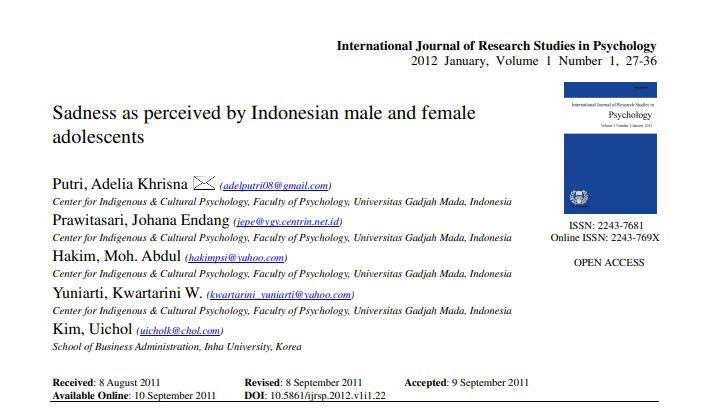
  • Sadness as perceived by Indonesian male and female adolescents

Sadness as perceived by Indonesian male and female adolescents

  • Journal Articles
  • 4 Februari 2022, 13.14
  • Oleh: admin
  • 0

ABSTRACT. Adolescence is a transition phase filled with doubt and instability. During these transitions, some obstacles are often perceived as more intense and frequently cause adolescents to feel sad. This study was aimed to identify how male and female adolescents perceived sadness. A total number of 461 students, 273 females and 188 males, all of whom were high school students in Yogyakarta, completed an open-ended questionnaire, developed by Kim and Park (2006). The data was categorized, open-coded, axial-coded, and later cross-tabulated. Results demonstrated that females perceive negative moments as a life-lesson (30.4%), self reflection (13.9%), disruption (13.6%), life’s obstacles (8.1%), motivation (6.6%), memorable moments (6.6%), and lastly as a spiritual-lesson (2.6%). While males view sadness as a life lesson (22.9%), disruption (15.4%), self-reflection (11.2%), motivation (9.6%), memorable moments (5.9%), life’s obstacles (5.3%), and lastly as a spiritual lesson (3.2%). This result was later divided into two types of perception, the positive approach, containing life lesson, self-reflection, motivation, and spiritual lesson, and the negative approach, which are sadness as disruption, memorable moments, and life’s obstacles. This study concludes that both Indonesian male and female adolescent mainly took a positive perception on sadness as a life lesson, with only 27% of them viewing it as negative.


Tinggalkan Komentar Batalkan balasan

Alamat email Anda tidak akan dipublikasikan. Ruas yang wajib ditandai *

*

Universitas Gadjah Mada

Alamat: Ruang D604 Gedung D lt. 6, Fakultas Psikologi Universitas Gadjah Mada, Jl. Humaniora No. 1 Bulaksumur, Sleman, Yogyakarta 55281 INDONESIA

Jam Kerja: 08.00 – 16.00
Telepon: (+62)274-550435 ext. 604
Humas CICP: (+62)857-2868-1391
Fax: (+62)274-550436

Email: cicp@cicp.psikologi.ugm.ac.id

Instagram: @cicp.ugm

© Universitas Gadjah Mada

KEBIJAKAN PRIVASI/PRIVACY POLICY